Keine Zollgebühren, weil wir aus deiner Region versenden. Versandkostenfrei ab 70 € / CHF 70 / $80 / £60
Unsere Website durchsuchen

Stoic Wisdom: Virtue over Victory

The stoics held that winning is outside your control and character is not, so only one of them is worth measuring yourself against.

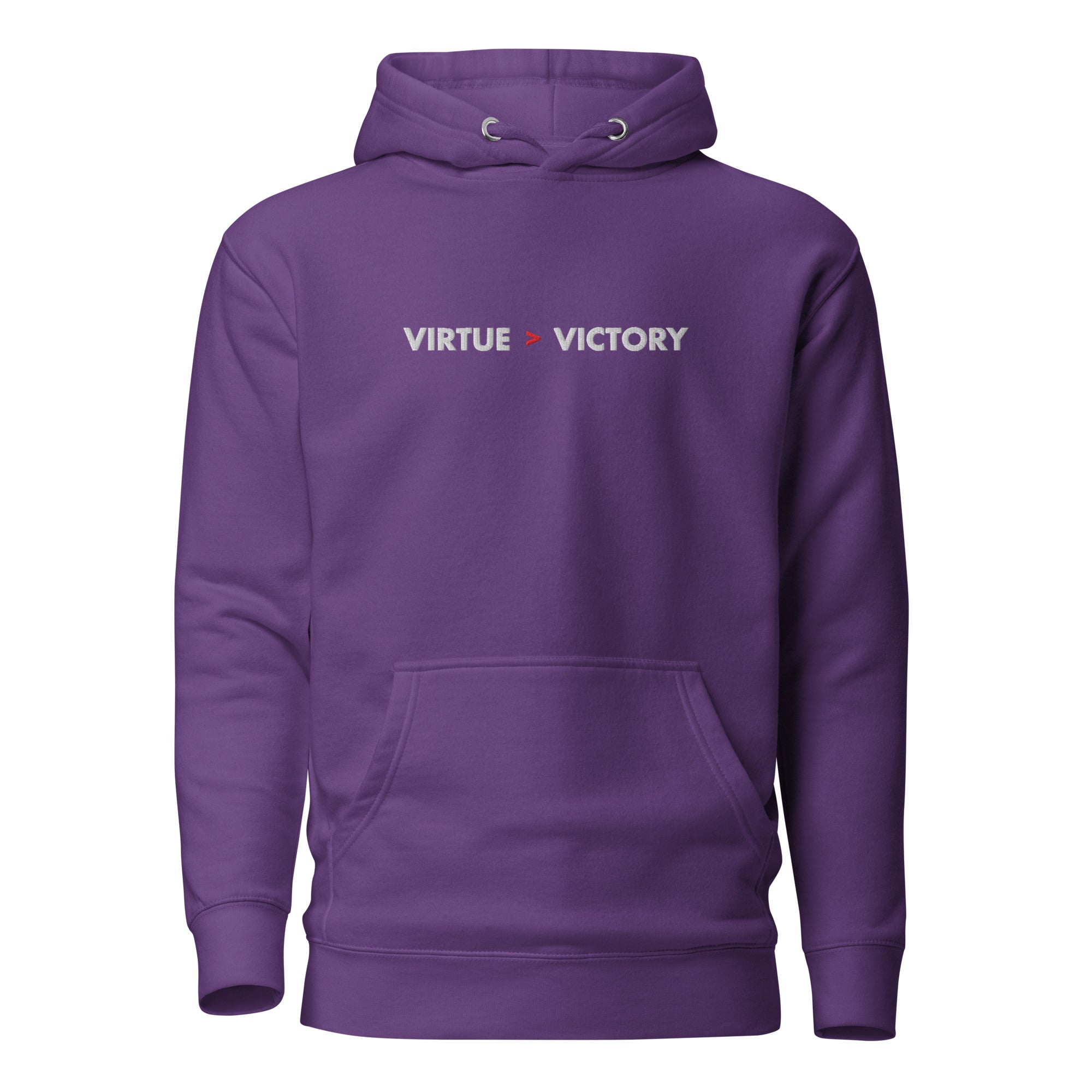
Discreet embroidery — the message would be undermined by shouting it. The full range here — tees, sweatshirts, hoodies and caps, all printed to order as you buy them. A Stoic philosophy gift for stoics. Lose well. It is the only part you own.


Questions about this design

What does the Virtue over Victory design mean?
The words Virtue and Victory are embroidered side by side, joined by a small red greater-than sign – virtue counts for more than winning. It is the Stoic idea in its shortest form; the result of a contest is never fully in your control, but how you conduct yourself is. The stitching is deliberately discreet, because a message about character would be undermined by shouting it.
What is virtue ethics?
Virtue ethics is the approach to morality that asks what kind of person to be rather than which rule to follow or which outcome to maximise. Its classic source is Aristotle’s Nicomachean Ethics, where virtues are stable traits of character, built by practice, that let a person flourish. It was revived in the 20th century by Elizabeth Anscombe’s Modern Moral Philosophy (1958) and Alasdair MacIntyre’s After Virtue (1981).
What is the Stoic dichotomy of control?
It is the opening idea of Epictetus’ Handbook, the Enchiridion – some things are up to us and some are not. Up to us are our judgements, intentions, desires and actions; not up to us are our body, reputation, property and outcomes. The Stoics concluded that peace of mind and goodness depend only on the first group, so a loss does not touch what matters most.
Did the Stoics think winning was important?
Not as a true good. For the Stoics only virtue is good and only vice is bad; everything else – victory, wealth, health, fame – is indifferent to happiness. Some indifferents are naturally preferred, so it is reasonable to train and to try to win, but a defeat suffered with integrity leaves a person no worse, and a victory won by cheating leaves them worse off.
What does arete mean?
Arete is the ancient Greek word for excellence, usually translated as virtue. Originally it meant being excellent at one’s function – a fast horse or a sharp knife has arete. Socrates, Plato and Aristotle turned it into moral excellence, the excellence of a human being, which for Aristotle includes courage, justice, temperance and practical wisdom, phronesis.
What is Aristotle’s golden mean?
In the Nicomachean Ethics Aristotle argues that each moral virtue lies in a mean between two vices, one of excess and one of deficiency. Courage lies between cowardice and recklessness, generosity between stinginess and extravagance. The mean is relative to us and the situation, not a mathematical midpoint, and finding it requires practical wisdom rather than a formula.
Why did Socrates say it is better to suffer injustice than to commit it?
In Plato’s Gorgias Socrates argues against the ambitious Callicles that doing wrong harms the wrongdoer’s own soul, which is the worst harm of all, while suffering wrong only harms what is external. A person who wins by injustice is therefore worse off than one who loses justly. It is perhaps the oldest philosophical case for virtue over victory.
Is Virtue over Victory a good gift for athletes, coaches or Stoics?
Yes – it suits athletes, coaches and team captains who care about fair play, readers of Stoic philosophy, and anyone who wants a quiet reminder that character outlasts the scoreboard. The embroidery is understated enough for everyday wear. The design comes as an embroidered classic T-shirt, embroidered sweatshirt, embroidered premium hoodie and cap.