No tariffs. Ever. We ship locally from the US, Canada, the UK, or the EU + Free shipping over $80 / 70€ / £60 (equivalent in all other currencies).
Search our site

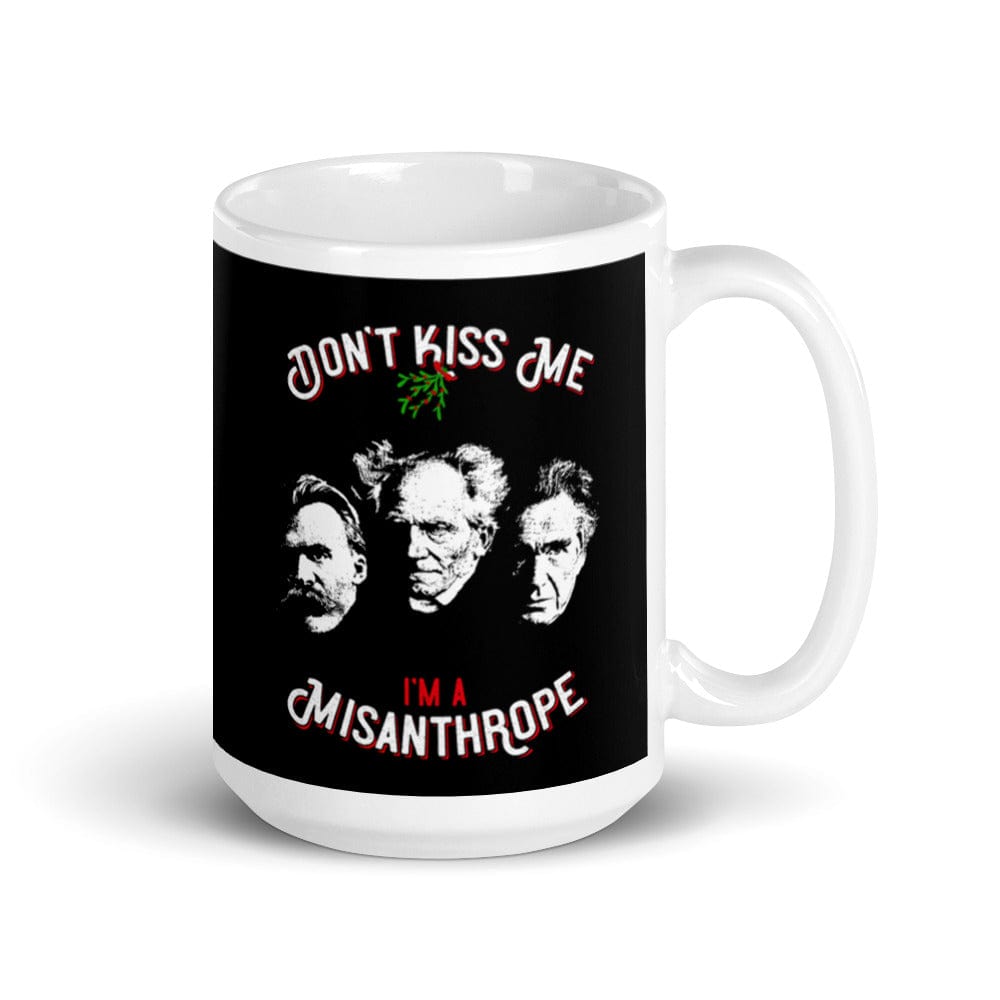
Don't kiss me, I'm a misanthrope

Nietzsche, Schopenhauer and Cioran walked separate paths to the same conclusion about other people. Consider this a formal notice.

Three of the gloomiest minds in the canon, assembled in agreement for once. The whole range here, from apparel through to accessories, all printed to order. A funny pessimist gift for pessimists. Keep your distance. They all recommended it.

Questions about this design

What does the Don't Kiss Me I'm A Misanthrope design show?
Three engraved-style portraits of Friedrich Nietzsche, Arthur Schopenhauer and Emil Cioran under a sprig of mistletoe, framed by the words Don’t Kiss Me – I’m A Misanthrope. Three of the gloomiest minds in the canon agree for once, on keeping people at a polite distance. It is the perfect seasonal answer to forced festive closeness.
What is a misanthrope?
A misanthrope is someone who dislikes or distrusts humankind in general. The word comes from Greek misos, hatred, and anthropos, human being. Misanthropy is different from introversion – an introvert recharges alone but may like people very much, while a misanthrope doubts human nature itself. Molière’s comedy Le Misanthrope (1666) made the type famous.
What is Schopenhauer’s hedgehog dilemma?
It is a parable in Schopenhauer’s Parerga and Paralipomena (1851). On a cold day a group of porcupines huddle together for warmth, but their quills prick each other, so they move apart, until the cold drives them together again. Eventually they find a moderate distance – which, Schopenhauer says, people call politeness and good manners. Freud later cited it in Group Psychology and the Analysis of the Ego (1921).
Was Schopenhauer a misanthrope?
He came close and did not hide it. Schopenhauer lived alone in Frankfurt with his poodles, thought most company tiresome and recommended solitude as the condition of a free mind. Yet his ethics rest on compassion – Mitleid – for all suffering beings, so his misanthropy is better read as disappointment with human behaviour than as hatred of humans.
Who was Emil Cioran?
Emil Cioran (1911–1995) was a Romanian-born philosopher and essayist who settled in Paris in 1937 and later wrote in French. His aphoristic books – On the Heights of Despair (1934), A Short History of Decay (1949) and The Trouble with Being Born (1973) – are among the darkest and wittiest in modern pessimism. He later disowned his far-right sympathies of the 1930s.
Was Nietzsche a misanthrope?
Not in the simple sense. Nietzsche despised the conformity of the herd and urged solitude – in Thus Spoke Zarathustra he writes, Flee, my friend, into your solitude. But he admired Schopenhauer only at first, in Schopenhauer as Educator (1874), and then rejected his pessimism for a radical affirmation of life. His contempt was aimed at mediocrity, not at people as such.
What is philosophical pessimism?
Philosophical pessimism is the view that existence contains more suffering than good, or that life has no value that could justify it. Its classic statement is Schopenhauer’s The World as Will and Representation (1818), where a blind, insatiable will drives all striving and so all suffering. Cioran radicalised the mood; Nietzsche accepted the diagnosis but not the verdict.
Why do people kiss under the mistletoe?
The custom is first recorded in 18th-century England, where a man could kiss someone standing beneath a mistletoe sprig, traditionally picking a berry for each kiss. Older associations are often cited – Pliny the Elder describes druids revering mistletoe, and in Norse myth Baldr is killed by a mistletoe dart – but the kissing itself is a modern folk tradition.
Is this a good gift for a misanthrope, introvert or philosophy lover?
Yes – it is a gift that says I respect your boundaries, and it is funnier for anyone who knows the three thinkers. It works for the office Secret Santa, the friend who leaves parties early or the philosophy student who quotes Schopenhauer. The design comes as a sweatshirt, a mug and a sticker.