No tariffs. Ever. We ship locally from the US, Canada, the UK, or the EU + Free shipping over $80 / 70€ / £60 (equivalent in all other currencies).
Search our site

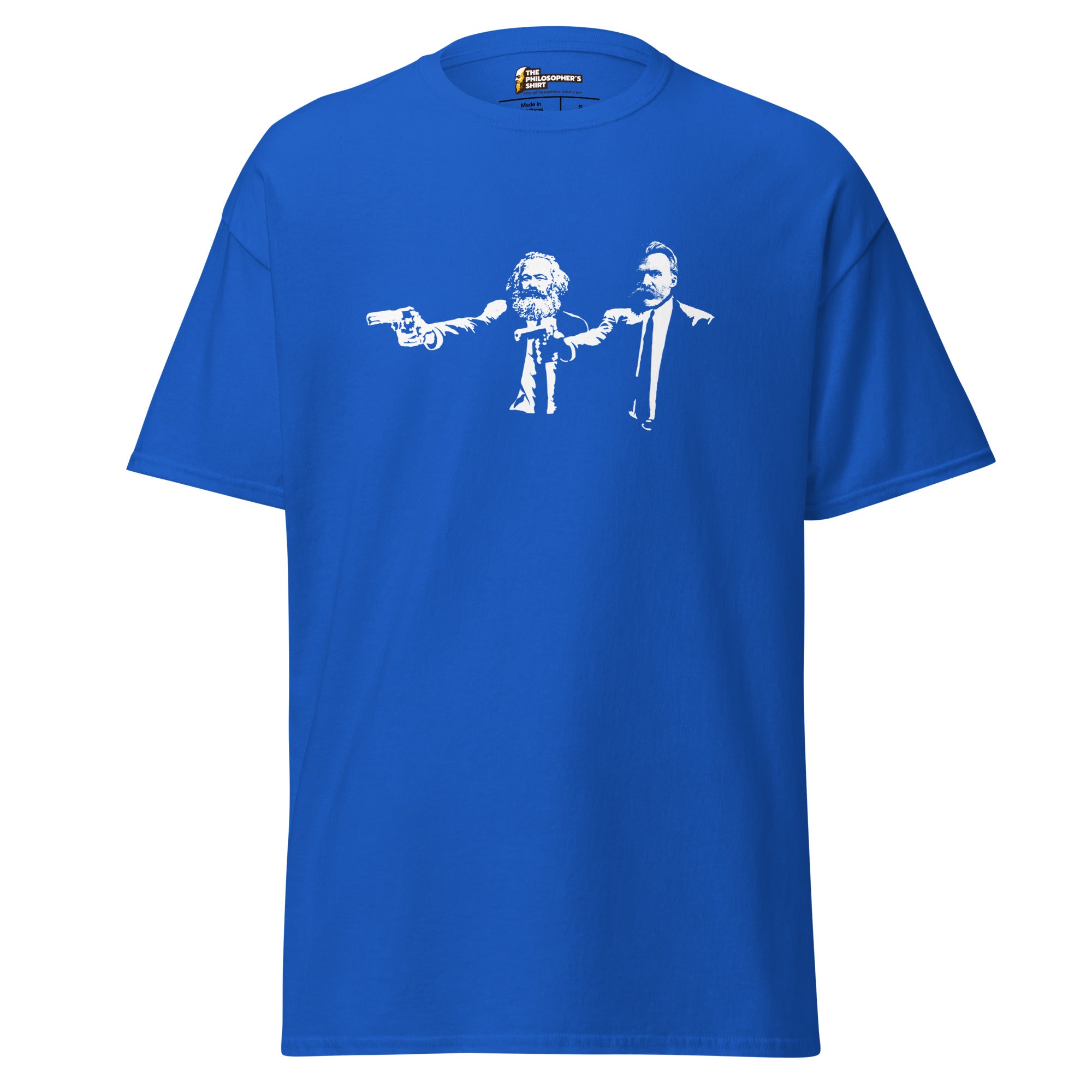
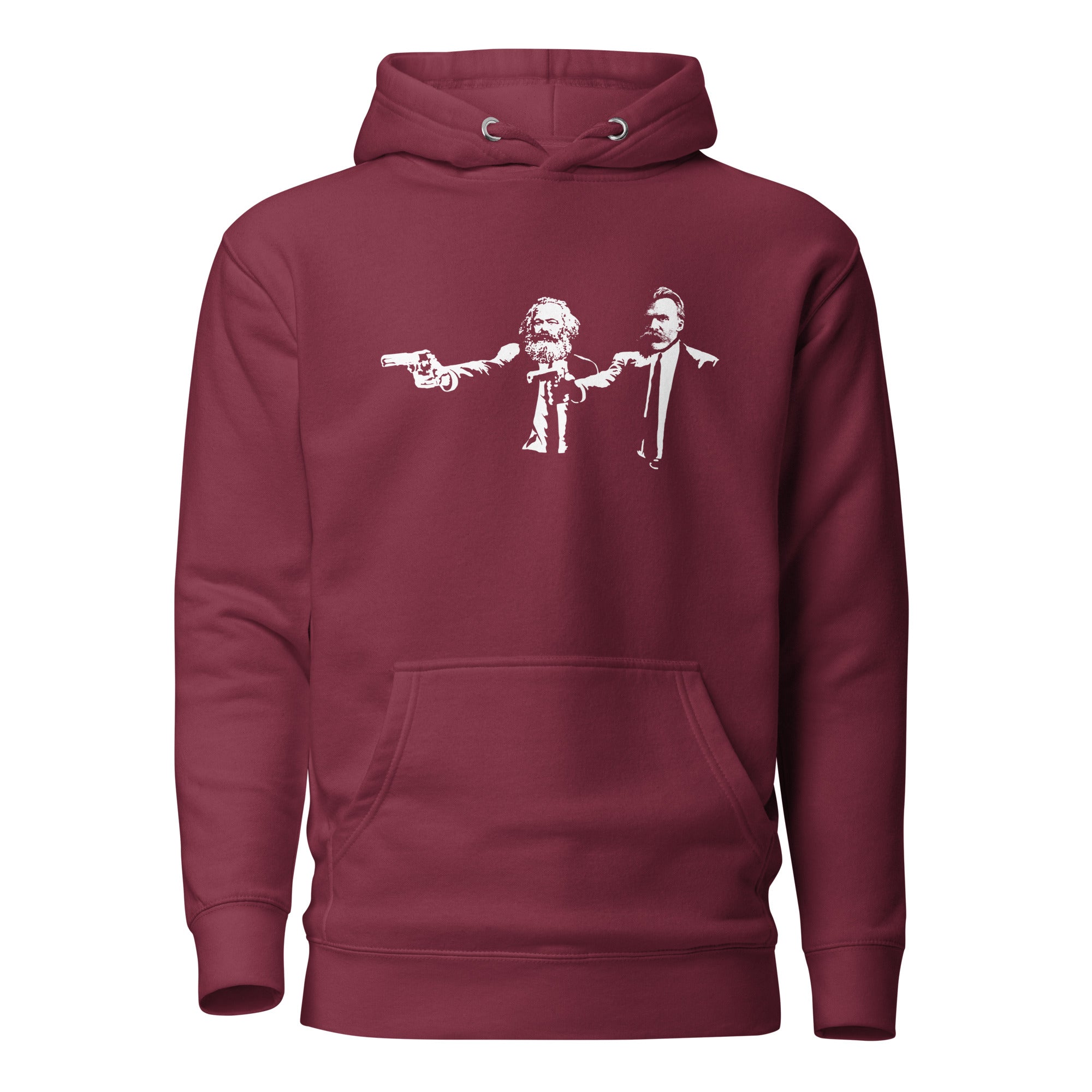
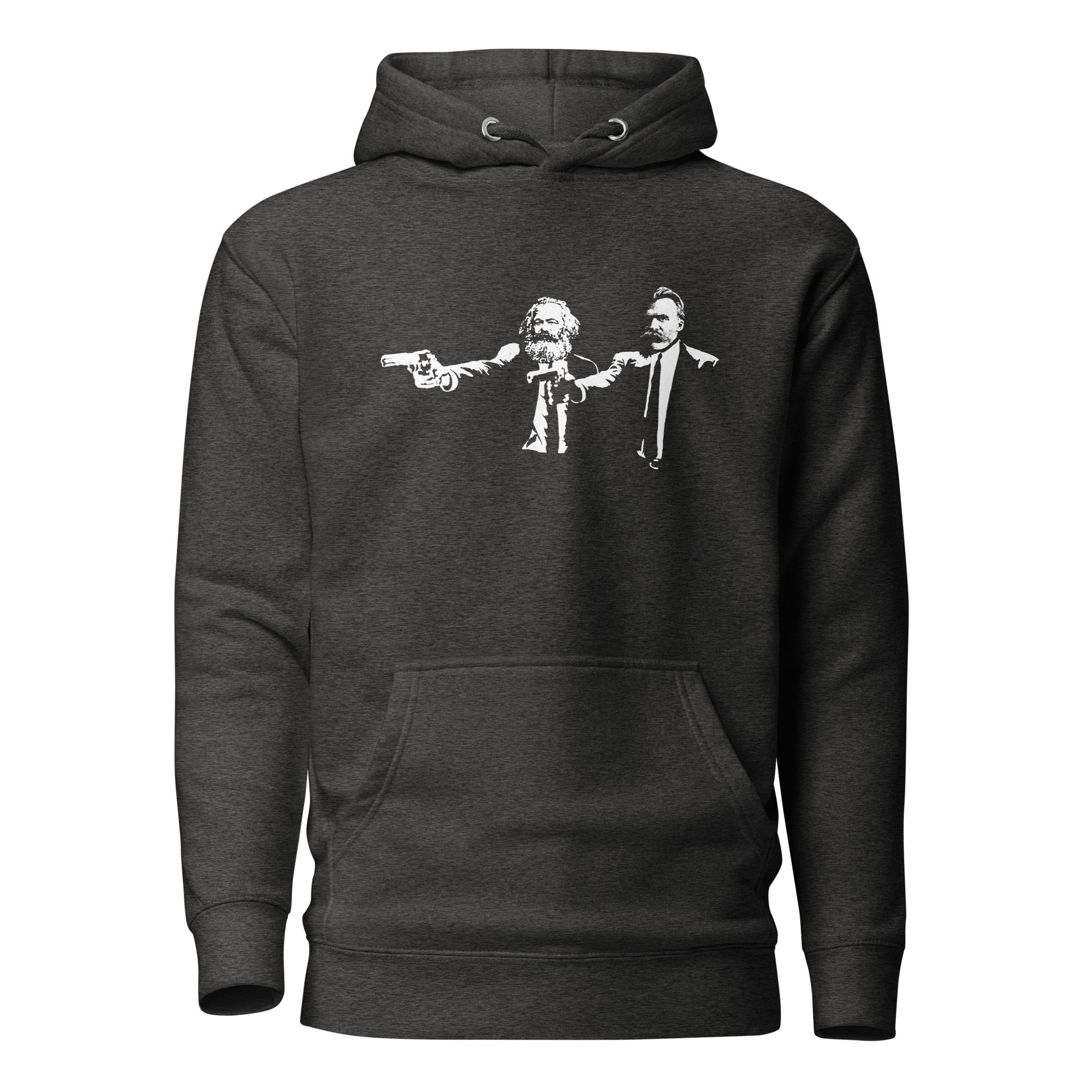
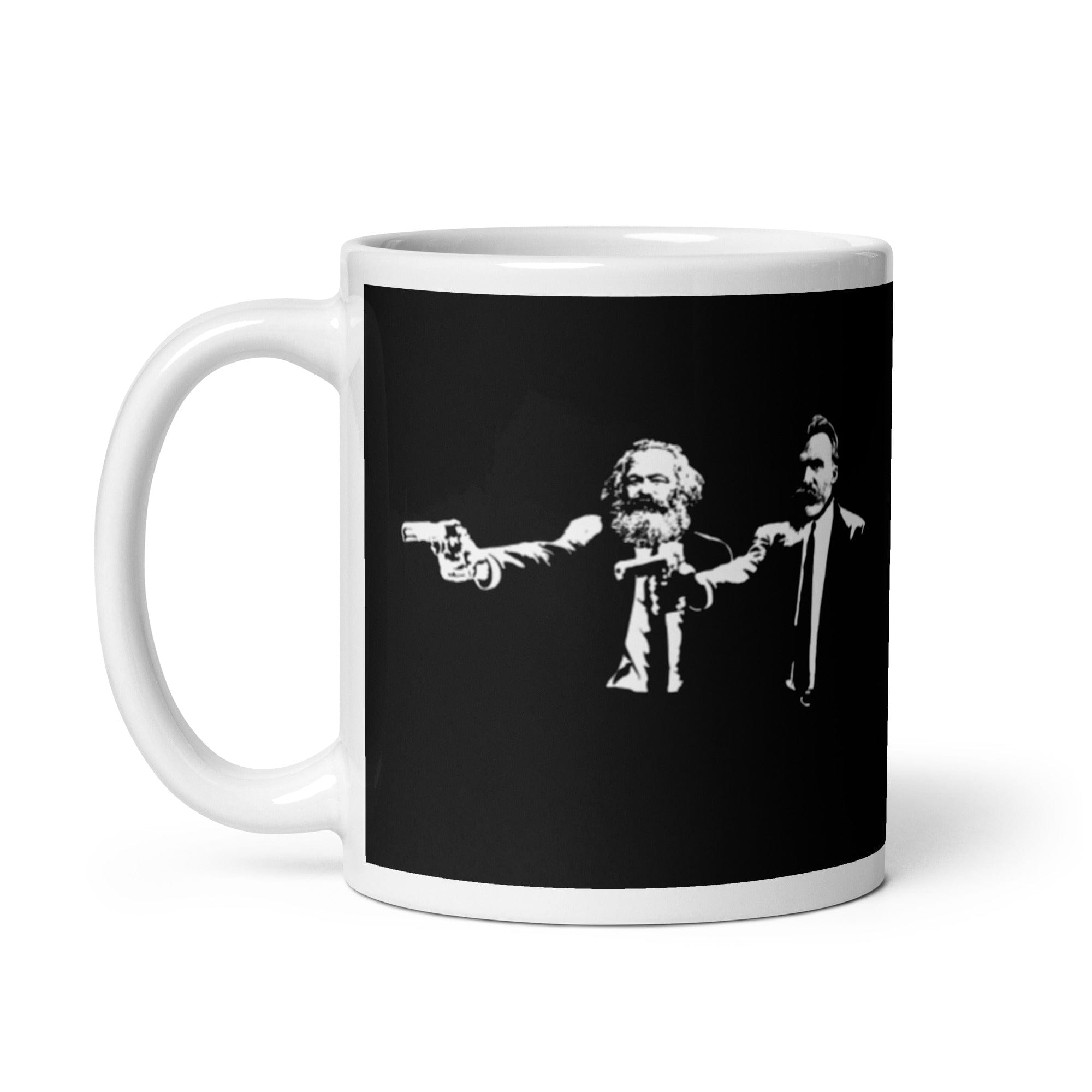
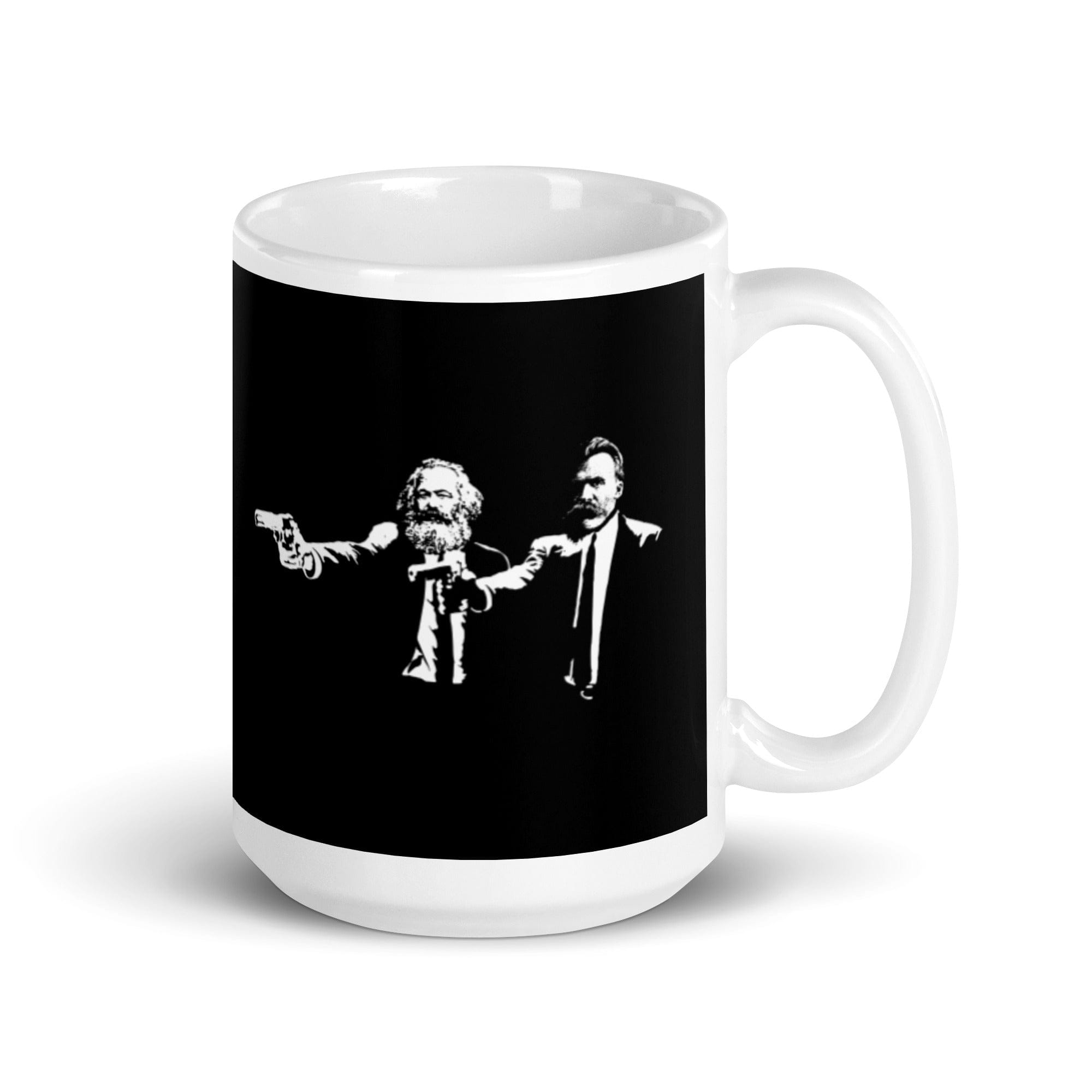
Philo Fiction - Marx & Nietzsche

Two nineteenth-century Germans who agreed on almost nothing, framed as partners in the same crime film. The dialogue would have been extraordinary.

The mismatch is the joke: class struggle meets the will to power. Everything in one place: tees, women's tees, sweatshirts and hoodies, made to order. One wants the revolution. The other wants you to stop needing one.

Questions about this design

What does the Philo Fiction Marx and Nietzsche design show?
Karl Marx and Friedrich Nietzsche side by side in black and white, each aiming a pistol, posed like two partners in a crime film, under the title Philo Fiction. The joke is the odd couple – two nineteenth-century Germans who agreed on almost nothing, one wanting revolution, the other a revaluation of all values – teamed up for one last job.
Did Marx and Nietzsche ever meet?
No. Marx (1818–1883) lived in London from 1849, while Nietzsche (1844–1900) taught in Basel and later wandered between Switzerland and Italy. Nietzsche never mentions Marx by name in his writings, although several books in his library discussed him, and there is no sign that Marx knew Nietzsche’s work.
What do Marx and Nietzsche have in common?
More than either would admit. Both trained in classics – Marx wrote his doctoral thesis on Democritus and Epicurus, Nietzsche became professor of classical philology in Basel at 24. Both unmasked religion and morality as expressions of hidden interests or instincts. Paul Ricœur grouped them with Freud as the masters of suspicion in Freud and Philosophy (1965).
What did Nietzsche think of socialism?
He was consistently hostile. In Beyond Good and Evil (1886) and elsewhere he treats socialism and democracy as secular heirs of Christian herd morality, driven by resentment and a wish to make everyone equal. Some later readers on the left nevertheless used his critique of conformity and his idea of self-creation, which is part of what makes the pairing on the design so absurd.
Did Nietzsche say religion is the opium of the masses?
No, that was Marx. The line comes from the introduction to his Contribution to the Critique of Hegel’s Philosophy of Right (1844), where religion is the sigh of the oppressed creature and the opium of the people. Nietzsche’s best-known line on religion is God is dead, from The Gay Science (1882). The two are often confused, which suits this design perfectly.
What does Nietzsche mean by God is dead?
In The Gay Science (1882), section 125, a madman announces that God is dead and that we have killed him. Nietzsche is not making a metaphysical proof but a cultural diagnosis – belief in the Christian God has lost its power in modern Europe, and with it the foundation of our morality and meaning. The challenge is to face the resulting nihilism and create new values.
What is Nietzsche’s Übermensch?
The overman or superman introduced in Thus Spoke Zarathustra (1883–1885). Zarathustra presents him as the meaning of the earth – a human being who overcomes inherited values and creates his own, affirming life without consolation in another world. It is an ideal of self-overcoming, not a biological or racial type; its later abuse by the Nazis distorted Nietzsche’s thought.
What is master and slave morality?
Nietzsche’s account in Beyond Good and Evil (1886) and On the Genealogy of Morality (1887). Master morality calls good what is noble, strong and life-affirming; slave morality arises from the resentment of the powerless and calls good what is humble, meek and pitying, while condemning strength as evil. Nietzsche saw Christian ethics as a victory of slave morality.
What is historical materialism?
Marx’s theory that the way a society produces its material life – its technology, labour and property relations – shapes its laws, politics and ideas. In the preface to A Contribution to the Critique of Political Economy (1859) he writes that it is not people’s consciousness that determines their being, but their social being that determines their consciousness. History moves through conflicts between classes.
Is this a good gift for philosophy students?
Yes. It suits philosophy, politics and history students, teachers and reading groups – anyone who has argued about whether Marx or Nietzsche got modernity right. Those who know the two thinkers get a joke about irreconcilable philosophies; everyone else gets two magnificent moustaches with guns.
Which products are available with this design?
Philo Fiction Marx and Nietzsche comes as a unisex classic T-shirt, a women’s T-shirt, a sweatshirt, a premium hoodie, a mug and a sticker – the sticker being the quickest way to start a debate on a laptop lid.