Niente dazi: spediamo dalla tua regione. Spedizione gratuita da 70 € / $80 / £60
Cerca nel nostro sito

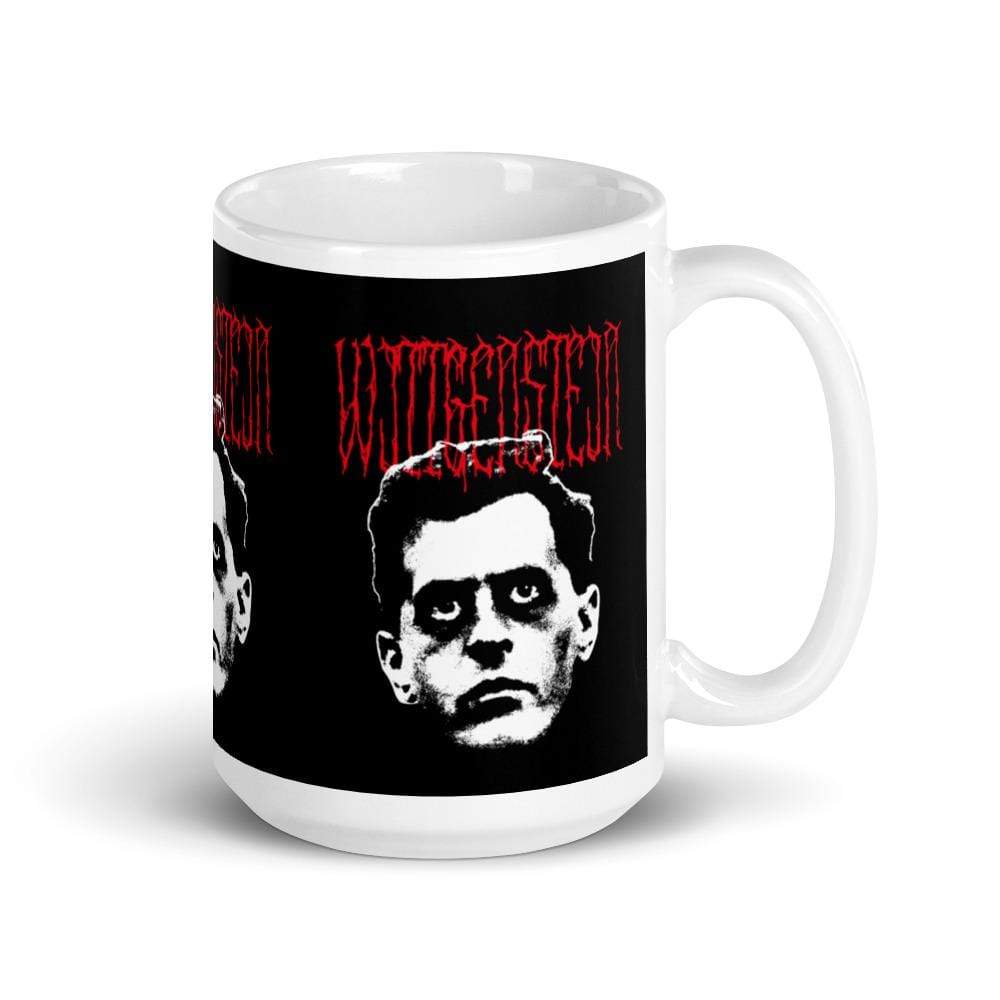
Metal Philosophers - Ludwig Wittgenstein

Whereof one cannot speak, thereof one must be silent — a sentiment metal has never once respected. The logo is deliberately almost illegible.

Illegible-band-logo styling done properly, not as a half-hearted gag. The full range, in every format we make it in, all printed to order as you buy it. A funny philosophy gift for metal fans. The limits of my language mean the limits of my merch.


Questions about this design

What does the Metal Philosophers Wittgenstein design show?
A stark black-and-white portrait of Ludwig Wittgenstein under his name in a jagged, dripping red logo in the style of extreme metal – deliberately almost unreadable. The joke is the clash – the philosopher who ended his first book with a command to be silent, dressed up in the loudest aesthetic there is, with a name you cannot quite read.
What does “Whereof one cannot speak, thereof one must be silent” mean?
It is proposition 7, the last sentence of Wittgenstein's Tractatus Logico-Philosophicus (1921; English 1922). The book argues that meaningful language pictures possible facts. Ethics, aesthetics, the meaning of life and the mystical cannot be stated in that way – they can only show themselves. Wittgenstein did not think they were unimportant; he thought they mattered too much to be turned into chatter.
What does “The limits of my language mean the limits of my world” mean?
It is proposition 5.6 of the Tractatus (Die Grenzen meiner Sprache bedeuten die Grenzen meiner Welt). For the early Wittgenstein, whatever can be thought can be said, and what lies beyond language cannot be thought as a fact at all. It is often quoted loosely as a claim that learning more words widens your world, but its original point is logical – language and world share the same form.
Who was Ludwig Wittgenstein?
Ludwig Wittgenstein (1889–1951) was an Austrian-British philosopher, often called the most important philosopher of the twentieth century. Born into one of Vienna's richest families, he studied with Bertrand Russell in Cambridge, wrote the Tractatus while serving in the First World War, gave away his fortune, taught at village schools in Austria and finally became a professor at Cambridge in 1939.
What is a language game in Wittgenstein?
In the Philosophical Investigations (published 1953, after his death) Wittgenstein compares speaking to playing games – giving orders, telling jokes, praying, reporting. Each activity has its own rules, and words get their meaning from how they are used within it. Hence his famous remark that the meaning of a word is in most cases its use in the language (§43).
What is the difference between early and late Wittgenstein?
The early Wittgenstein of the Tractatus sees language as a logical picture of the world with one hidden structure. The later Wittgenstein of the Philosophical Investigations rejects this and treats language as a family of practices, language games woven into forms of life. Unusually, he became his own most important critic and changed philosophy twice.
What is Wittgenstein's beetle in a box?
A thought experiment from the Philosophical Investigations (§293). Imagine everyone has a box with something they call a beetle, but nobody can look into anyone else's box. The word beetle could still work in their language, yet the thing in the box drops out as irrelevant. Wittgenstein uses it to show that words for private sensations such as pain cannot get their meaning from a purely inner object.
Which Wittgenstein book should I read first?
Start with the Blue and Brown Books (dictated 1933–35, published 1958), the most accessible way into the later thought, then the Philosophical Investigations (1953). The Tractatus (1921) is short but dense; read it with a good commentary. For the life behind the work, Ray Monk's biography Ludwig Wittgenstein – The Duty of Genius (1990) is the standard choice.
Is the Wittgenstein metal shirt a good gift for a philosophy student?
Yes – it is a favourite with philosophy students, logicians, linguists and metalheads who read. People who know Wittgenstein enjoy the irony of an unreadable name for the philosopher of meaning; everyone else simply sees a great band-style shirt. The design is available as a classic unisex T-shirt, a sweatshirt, a premium hoodie, a mug and a sticker.