Niente dazi: spediamo dalla tua regione. Spedizione gratuita da 70 € / $80 / £60
Cerca nel nostro sito

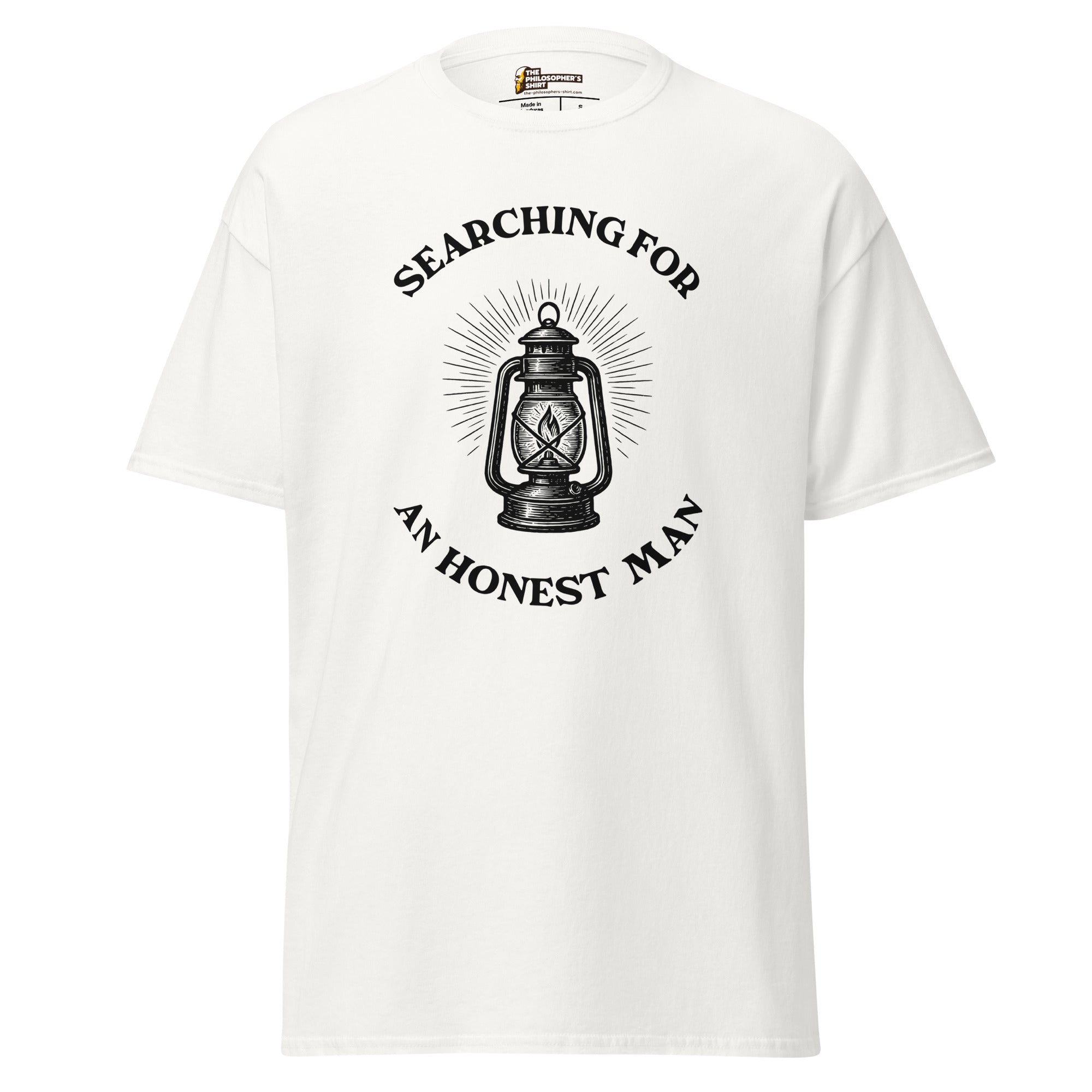
Diogenes' Lantern - Searching for an honest man

Diogenes carried a lit lantern through Athens in broad daylight, telling anyone who asked that he was looking for an honest man. He never reported success.

Cynicism as a discipline, not a mood — and considerably funnier for it. The full range here — tees, sweatshirts, hoodies and mugs, all printed to order as you buy them. A Greek philosophy gift for cynics. Still searching. Bring your own lamp.

Questions about this design

What does the Diogenes’ Lantern design show?
An old oil lantern glowing with rays of light, framed by the words Searching For An Honest Man. It refers to the most famous story about Diogenes of Sinope, who walked through Athens in broad daylight carrying a lit lamp. No portrait, no name – just the lamp, which anyone who knows the anecdote recognises immediately.
Why did Diogenes carry a lamp in daylight?
According to Diogenes Laertius in his Lives of Eminent Philosophers (Book VI, 41), Diogenes lit a lamp in broad daylight and went about saying that he was looking for a human being. The point was provocation – among all the crowds of the city he claimed he could not find one person living truly according to reason and nature, free of convention, vanity and pretence.
Did Diogenes really say he was looking for an honest man?
Not in those words. The ancient source says only that he was looking for a man or a human being (anthrōpon zētō). The version with an honest man is a later retelling that became standard in modern languages. It captures his intention well enough, but strictly it is a paraphrase, not a quotation.
Who was Diogenes of Sinope?
A Greek philosopher born in Sinope on the Black Sea around 412 or 404 BC and died in Corinth in 323 BC. Exiled after a scandal over defacing coins, he came to Athens and became the most famous Cynic. He lived in deliberate poverty, mocked social convention and Plato alike, and taught mainly through shocking public acts and sharp one-liners rather than books.
What is the difference between ancient Cynicism and modern cynicism?
Ancient Cynicism was a demanding way of life – live according to nature, need as little as possible, ignore status and convention, and say the truth bluntly (parrhēsia). Modern cynicism usually means a distrust of other people’s motives. The ancient Cynics were not sneering pessimists but radical moralists who believed virtue is enough for happiness; they later strongly influenced the Stoics.
Did Diogenes really live in a barrel?
Not a barrel – wooden barrels were not common in classical Greece. Ancient sources say he lived in a pithos, a large ceramic storage jar, in Athens. Barrel is a later translation that stuck. He also reportedly threw away his only cup when he saw a boy drinking from his hands, realising he had been carrying something unnecessary.
What did Diogenes say to Alexander the Great?
According to Plutarch’s Life of Alexander and Diogenes Laertius, Alexander found Diogenes sunning himself in Corinth and offered him anything he wished. Diogenes asked him to stand a little out of his sunlight. Alexander is said to have remarked that if he were not Alexander, he would wish to be Diogenes. Whether the meeting really happened is uncertain, but the story was famous in antiquity.
What is the story of Diogenes and Plato’s featherless biped?
Diogenes Laertius (Book VI, 40) reports that Plato defined man as a featherless animal with two legs and was applauded. Diogenes plucked a chicken, brought it into the lecture room and said, here is Plato’s man. Plato’s definition was then amended to include having broad nails. It is the ancient original of today’s Diogenes memes.
Why is Diogenes syndrome named after Diogenes?
Diogenes syndrome describes severe self-neglect, often with hoarding and squalid living conditions, mostly in older people. The name was popularised by a 1975 clinical study in The Lancet. Many scholars find the label unfair – the real Diogenes chose voluntary simplicity and owned almost nothing, which is the opposite of hoarding.
Who is the Diogenes’ Lantern design a good gift for?
For philosophy students, classicists, anyone with a weakness for Cynics and Stoics, and every friend who has ever complained about the honesty of the world. It is available as a unisex classic T-shirt, sweatshirt, premium hoodie, mug and sticker.