


Philosophical Dictionary
-
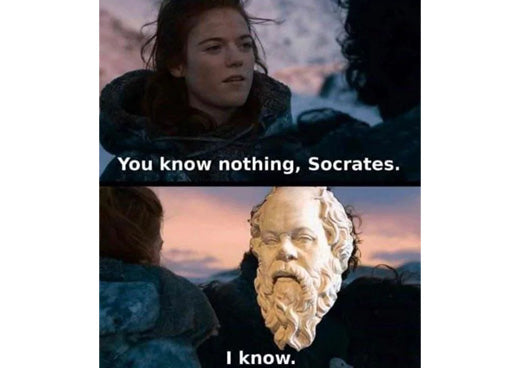
Do You Really Know What You Know, You Know?
By C.M. Black
In which we discuss epistemology in the terms of Socrates and his final dialogue, the Apology. What do we know? How do we know it? We touch on this from the context of the founder of Western philosophy. -

Socrates Memes Explained: Corrupting the Youth, the Hemlock and David’s Death of Socrates
By Markus Uehleke
Socrates memes keep returning to two scenes: a trial for corrupting the youth of Athens and a cup of poison in a prison cell. We read the charge in Plato’s Apology, the death in the Phaedo and Jacques-Louis David’s famous painting, then check the memes against them. How much did the internet get right? -

On Truth and Lies in a Nonmoral Sense: Nietzsche, Perspectivism and the Ethics Meme
By Markus Uehleke
Is the dog a good boy? Depends on your ethical theory, says the meme. Nietzsche went further in 1873: truth itself is a mobile army of metaphors, and being truthful means lying by convention. He never published the essay, and his famous “no facts” line sits in a notebook. So did he hand us post-truth? -

Conclusion Shopping: Confirmation Bias, Echo Chambers and “Do Your Own Research”
By Markus Uehleke
“You are conclusion shopping your insane hypothesis.” The meme names confirmation bias, which Francis Bacon described in 1620 and psychologists caught in a 1960 number game. Echo chambers make it worse, and a Nature study found checking false news online can raise belief in it. So what does honest research look like?


