No tariffs. Ever. We ship locally from the US, Canada, the UK, or the EU + Free shipping over $80 / 70€ / £60 (equivalent in all other currencies).
Search our site

Russell's Teapot

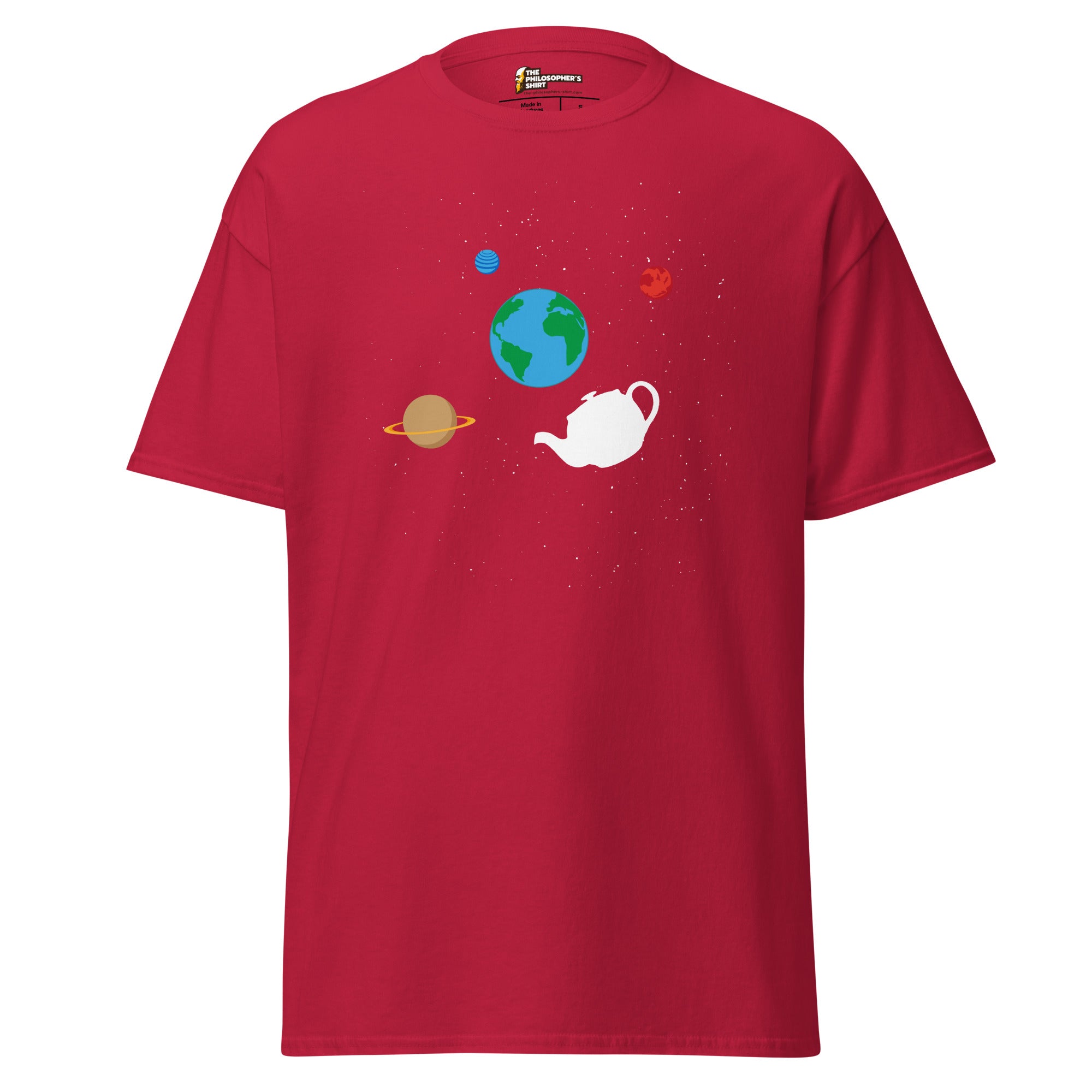
Russell asked why an unfalsifiable teapot orbiting the sun deserves less respect than any other claim made without evidence. Nobody has answered yet.

The argument does the work, so the design does not have to shout. Every format we print it on, made to order as you buy it, from apparel to accessories. An atheist gift for skeptics. The burden of proof sits with whoever brought the teapot.

Questions about this design

What does the Russell's Teapot Floating in Space design show?
A small white china teapot drifting through a starry sky between Earth, Mars, a ringed Saturn and a distant blue planet. No text, no explanation – which is the point. Anyone who knows Bertrand Russell's analogy gets the argument at a glance; anyone who does not will ask, and then you get to explain the burden of proof.
What is Russell's teapot?
An analogy by Bertrand Russell about the burden of proof. He imagined claiming that a china teapot orbits the sun between Earth and Mars, too small to be seen even by the most powerful telescopes. Nobody could disprove it – but, Russell said, if he then insisted it was intolerable presumption to doubt it, he would rightly be thought to be talking nonsense. Unfalsifiable is not the same as believable.
Where did Bertrand Russell write about the teapot?
In an essay titled Is There a God?, written in 1952 for a periodical that never printed it. It was published only after his death, in volume 11 of The Collected Papers of Bertrand Russell, Last Philosophical Testament 1943–68. The teapot spread through later quotations and became one of the best-known thought experiments in philosophy of religion.
What is the point of Russell's teapot?
That the burden of proof lies with the person making a claim, not with the sceptic. If a claim is framed so that no evidence could ever count against it, the impossibility of disproving it is no reason to believe it. Russell applied this to religious dogma, but it works for any untestable assertion – the old Latin maxim says what is freely asserted may be freely denied.
Was Bertrand Russell an atheist or an agnostic?
Both, depending on the audience. In his 1947 essay Am I an Atheist or an Agnostic? he said that, speaking to philosophers, he would call himself an agnostic, because he could not prove there is no God; speaking to ordinary people, he would say atheist, because in practice he treated the Christian God as about as likely as the gods of Olympus. The teapot captures exactly that position.
What are the main criticisms of Russell's teapot?
Philosophers such as Alvin Plantinga and Peter van Inwagen argue the analogy is weaker than it looks. A teapot is a physical object we have good background reasons to doubt – nobody launched one – whereas God is proposed as the explanation of the whole cosmos, not one more item within it. Others reply that every claim, positive or negative, carries some burden of proof.
Is Russell's teapot the same as Sagan's dragon in the garage?
They make a similar point. In The Demon-Haunted World (1995), Carl Sagan imagines someone who claims to keep a fire-breathing dragon in his garage – invisible, floating, heatless, leaving no trace. Each test is met with a new excuse, until it is unclear what the claim even means. Russell's teapot targets the burden of proof; Sagan's dragon targets claims that cannot be tested at all.
Who was Bertrand Russell?
A British philosopher, logician and public intellectual (1872–1970). With Alfred North Whitehead he wrote Principia Mathematica (1910–1913), an attempt to ground mathematics in logic, and he discovered the paradox named after him. He won the Nobel Prize in Literature in 1950, wrote the bestselling A History of Western Philosophy (1945) and was jailed twice for his pacifist and anti-nuclear activism.
Is the Russell's Teapot design a good gift?
Yes – for sceptics, science lovers, philosophy and logic students, debate-club regulars and anyone who has ever said the burden of proof is on you. It also works as a quiet conversation starter for tea drinkers. The design comes as a sweatshirt, premium hoodie, classic and women's T-shirt, and as a mug, which seems only fair.