No tariffs. Ever. We ship locally from the US, Canada, the UK, or the EU + Free shipping over $80 / 70€ / £60 (equivalent in all other currencies).
Search our site

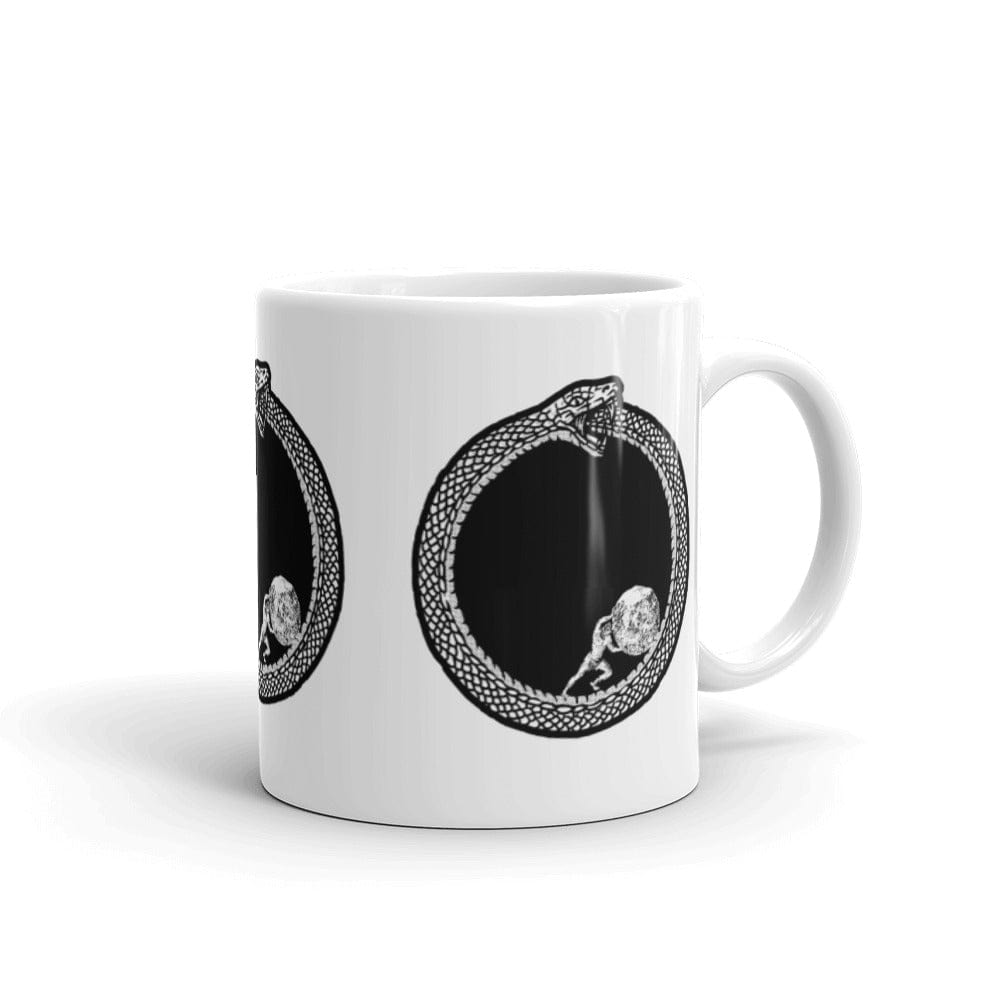
Sisyphus in Ouroboros

Two symbols of endlessness, folded into each other. The hill has no top and the snake has no end, which is one way of describing a career.

A closed circular composition that works especially well large. The full range, in every format we make it in, all printed to order as you buy it. An absurdist gift for Camus readers. The loop closes. Then it opens. Then it closes.

Questions about this design

What does the Sisyphus in Ouroboros design show?
An ouroboros – a serpent biting its own tail – drawn as a white engraving-style circle, with Sisyphus pushing his boulder along the inside of its body. Because the snake’s body is the slope, the climb has no top and no end. It joins two ancient images of endless repetition into one picture of what Albert Camus called the absurd.
What does one must imagine Sisyphus happy mean?
It is the last line of Albert Camus’ essay The Myth of Sisyphus (1942). Sisyphus knows his labour is pointless and will never end, yet in that lucid awareness he stops being its victim. The struggle itself toward the heights is enough to fill a man’s heart, Camus writes. Happiness here is not hope for an outcome but defiant, clear-eyed acceptance of life without ultimate meaning.
What is absurdism?
The philosophy associated with Albert Camus. The absurd is the clash between our longing for meaning and clarity and the unreasonable silence of the world. Camus rejects three escapes – physical suicide, philosophical suicide (a leap into faith or a system that explains everything) and despair – and instead calls for revolt, freedom and passion lived fully within that tension.
Who was Sisyphus and why was he punished?
In Greek mythology Sisyphus was the cunning king of Ephyra, later Corinth. He betrayed the secrets of Zeus and even cheated death, in one version by chaining Thanatos. As punishment he was condemned in the underworld to roll a huge boulder up a hill, only for it to roll down again each time, forever. Homer already describes the scene in Book 11 of the Odyssey.
What does the ouroboros symbolise?
A serpent or dragon eating its own tail stands for eternal cycles – death and rebirth, endings that are beginnings, the unity of all things. One of the earliest known examples appears on a shrine from Tutankhamun’s tomb in the 14th century BCE; later it became a key emblem of Greek alchemy. Philosophers often link it to Nietzsche’s eternal recurrence, the idea of living the same life again and again.
Is absurdism the same as nihilism?
No. Nihilism concludes that because life has no inherent meaning, nothing matters. Camus starts from the same lack of given meaning but refuses that conclusion – the absurd is a starting point, not a verdict. In The Rebel (1951) he explicitly argues against nihilism and builds an ethics of revolt, solidarity and limits on it.
What is the difference between absurdism and stoicism?
Stoicism holds that the cosmos is rationally ordered by logos, so we find peace by living in accordance with nature and accepting what we cannot control. Absurdism denies any such rational order – the universe is silent. Both counsel acceptance and inner freedom, but the Stoic accepts because the world makes sense, while Camus’ absurd hero accepts, and rebels, although it does not.
Was Camus an existentialist?
He refused the label. In a 1945 interview he said plainly that he was not an existentialist, and he later broke publicly with Jean-Paul Sartre. Existentialists hold that existence precedes essence and that we create our own meaning; Camus doubted any meaning could be created to resolve the absurd. He is usually grouped with existentialism in courses, but absurdism is the more precise name.
Which Camus book should I read first?
Start with the novel The Stranger (1942), then the essay The Myth of Sisyphus (1942), which explains its philosophy. The Plague (1947) shows solidarity in the face of the absurd, and The Rebel (1951) develops the political side. Camus received the Nobel Prize in Literature in 1957, aged 43.
Who is the Sisyphus in Ouroboros design a good gift for?
Readers of Camus, philosophy students, anyone stuck in a Monday-to-Friday loop who still chooses to smile, and people who like quiet, symbolic designs over slogans. It is available as a T-shirt, women’s T-shirt, sweatshirt, premium hoodie, embroidered tee, sweatshirt and hoodie, mug and sticker.