No tariffs. Ever. We ship locally from the US, Canada, the UK, or the EU + Free shipping over $80 / 70€ / £60 (equivalent in all other currencies).
Search our site

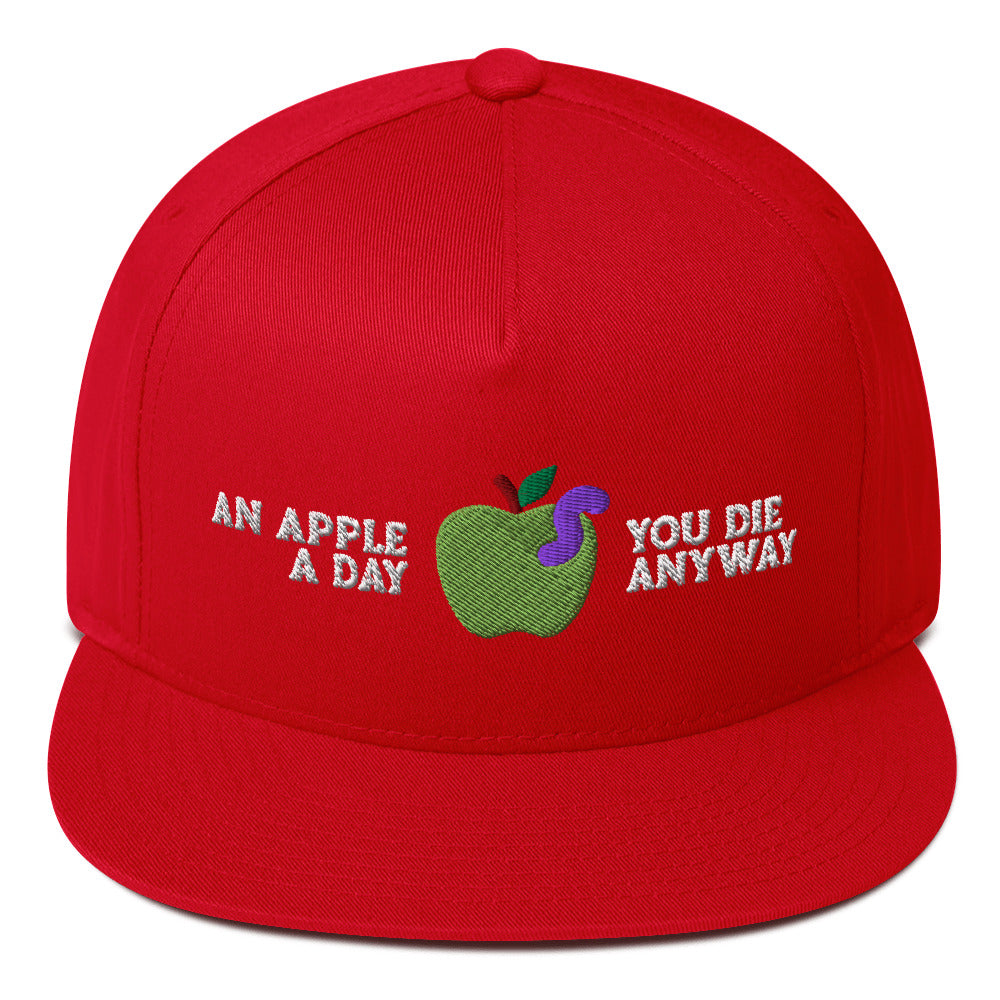
An Apple a day, you die anyway

One apple allegedly gave Newton gravity, another gave Eve knowledge and considerable trouble. Fruit has an outsized role in intellectual history.

Small embroidery carrying two of the most consequential apples on record. The whole range: tees, sweatshirts, hoodies and caps, printed to order as you buy them. An apple a day keeps the paradigm shifting.


Questions about this design

What does the An Apple a Day design say and what is the joke?
The embroidery reads “An apple a day … you die anyway”, with a small red apple and a purple worm wriggling out of it. It takes the cheerful health proverb and finishes it the way a philosopher would – with a memento mori. Eat well, by all means; the apple still will not exempt you from mortality, and the worm already knows it.
Where does the saying “an apple a day keeps the doctor away” come from?
The earliest recorded version is Welsh, printed as a Pembrokeshire proverb in Notes and Queries in 1866 – “Eat an apple on going to bed, and you’ll keep the doctor from earning his bread.” Shorter forms closer to today’s wording appear in print from the late 1880s and eventually became the familiar English proverb.
Does an apple a day really keep the doctor away?
Not literally. A 2015 study in JAMA Internal Medicine compared daily apple eaters with other US adults. Once sociodemographic and health factors were taken into account, apple eaters did not visit the doctor less often, although they were somewhat less likely to use prescription medication. Apples are a good food – they just cannot keep the promise the proverb makes, which is where the design begins.
What does memento mori mean?
Memento mori is Latin for “remember that you must die”. It names the old practice of keeping mortality in view – not to be gloomy but to live with focus. The Stoics made it a daily discipline; Seneca’s letters return to it constantly, and Marcus Aurelius reminds himself in the Meditations how fleeting all mortal things are. The skulls, candles and hourglasses of 17th-century vanitas paintings carry the same message; a wormy apple is a small vanitas.
What did Epicurus say about death?
Epicurus (341–270 BC) taught that “death is nothing to us”. In his Letter to Menoeceus he argues that all good and bad lies in sensation and death is the end of sensation; so while we exist death is not present, and when death is present we no longer exist. Fearing it is therefore pointless. Lucretius developed the argument in Book III of On the Nature of Things.
What does “to philosophize is to learn to die” mean?
It is the title of one of Montaigne’s Essays (Book I, chapter 19 or 20 depending on the edition, first published 1580). Montaigne opens with Cicero, who was echoing Plato’s Phaedo, where Socrates calls philosophy a practice for dying. The idea is not morbid – whoever has thought death through loses the fear of it and is free to live. Whoever has learned to die, Montaigne writes, has unlearned servitude.
Was the forbidden fruit in the Garden of Eden really an apple?
Genesis never names it; it speaks only of the fruit of the tree of the knowledge of good and evil. Early commentators proposed the fig, grape, pomegranate or citron. The apple took over in Western art from about the 12th century. It is often explained by the Latin pun malum (apple) and malum (evil), but scholars point more to the Old French word pom, which first meant any fruit and later only apple.
Did an apple really fall on Isaac Newton’s head?
There is no evidence that it hit him. Newton told the story himself to his friend William Stukeley in 1726 – the fall of an apple at Woolsthorpe in the mid-1660s had set him wondering why it always drops straight towards the ground. Stukeley recorded it in his Memoirs of Sir Isaac Newton’s Life (1752). The knock on the head is a later embellishment.
Who is the An Apple a Day design a good gift for?
For anyone with a dark sense of humour and a healthy lifestyle they do not take too seriously – philosophy students reading the Stoics or Epicurus, nurses and doctors, gym regulars and friends who send memento mori memes. The design comes as a small embroidery on a classic T-shirt, sweatshirt, premium hoodie and cap, and on a mug.