No tariffs. Ever. We ship locally from the US, Canada, the UK, or the EU + Free shipping over $80 / 70€ / £60 (equivalent in all other currencies).
Search our site

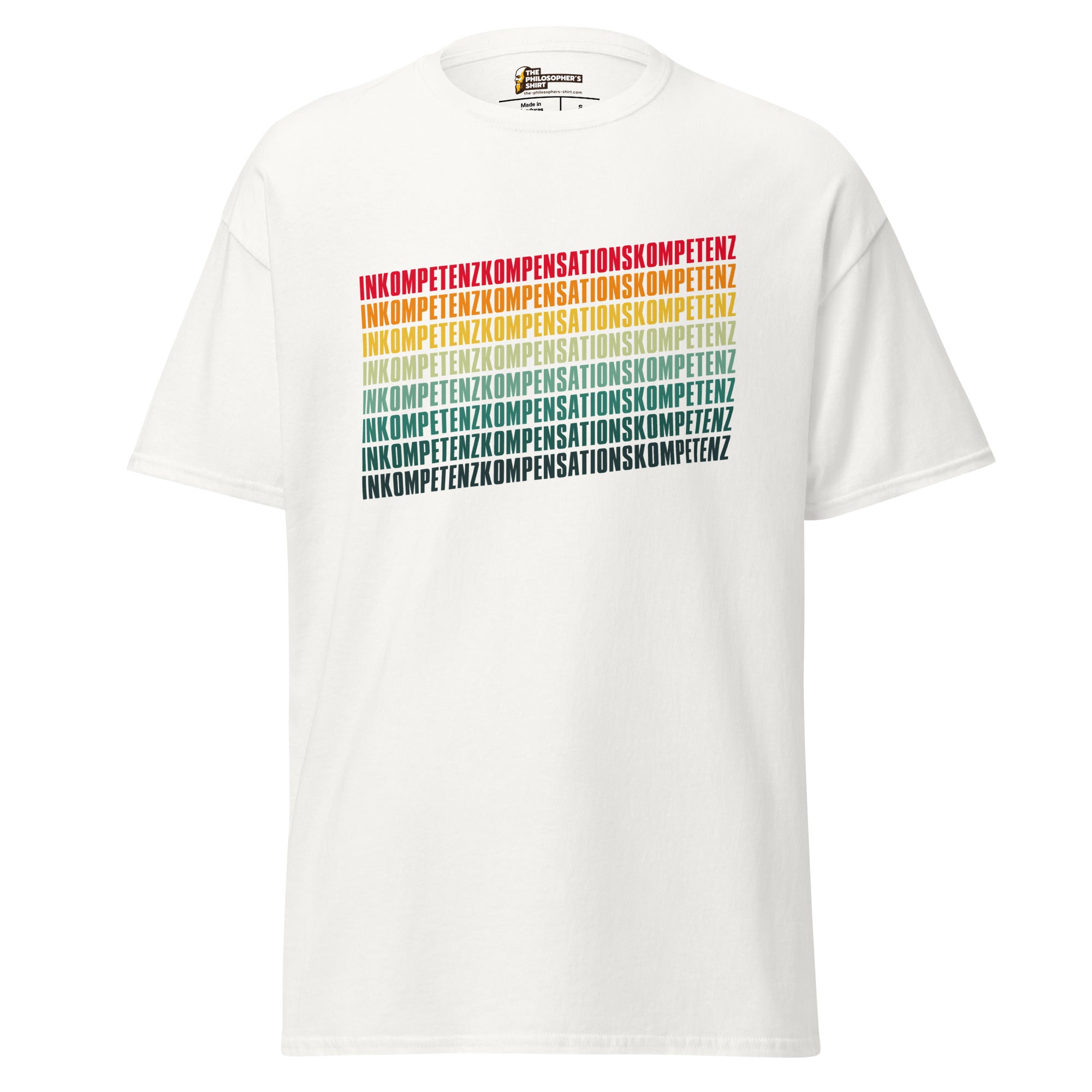
Inkompetenzkompensationskompetenz

A genuine German compound noun meaning the competence to compensate for incompetence. Every meeting you have ever sat through, in a single unpronounceable word.

Nobody can read it aloud on the first attempt, and everybody tries. The full range, in every format we make it in, all printed to order as you buy it. Sixteen syllables of bureaucratic self-awareness, worn without apology.

Questions about this design

What does the Inkompetenzkompensationskompetenz design show?
The single German word INKOMPETENZKOMPENSATIONSKOMPETENZ, stacked eight times in narrow capitals with a gentle wave, fading from red through orange and yellow to green and dark teal. The repetition makes a 33-letter word look even longer, which is precisely the point.
What does Inkompetenzkompensationskompetenz mean?
Literally, the competence to compensate for incompetence – the skill of covering or making up for what you do not actually know, through confidence, rhetoric, good questions or knowing whom to ask. Used ironically, it describes many meetings, exams and expert panels; used kindly, it is a genuine and useful skill.
Who coined the word Inkompetenzkompensationskompetenz?
The German philosopher Odo Marquard, in an essay collected in Abschied vom Prinzipiellen (1981). He applied it with characteristic self-irony to philosophy itself – having lost its old universal claims to the sciences, philosophy's real competence, he suggested, is dealing well with its own incompetence.
Who was Odo Marquard?
A German philosopher (1928–2015) who taught at the University of Giessen from 1965 to 1993. A sceptic in the hermeneutic tradition, he wrote on human finitude, contingency and compensation, defended pluralism against grand philosophies of history, and was famous for witty, quotable essays such as Apologie des Zufälligen (1986).
Why are German words so long?
Because German writes compound nouns as one word. Nouns can be chained almost without limit; the last element sets the basic meaning and grammatical gender, and each earlier part narrows it down. English says competence for compensating incompetence; German just glues the pieces together.
What is the longest German word?
The most famous is Rindfleischetikettierungsüberwachungsaufgabenübertragungsgesetz – 63 letters, part of a beef-labelling law in Mecklenburg-Western Pomerania that was repealed in 2013. Because compounds are open-ended, there is no true longest word; dictionaries simply record the longest ones in actual use.
What is the Dunning–Kruger effect?
A finding by psychologists Justin Kruger and David Dunning, published in 1999 under the title Unskilled and Unaware of It; people with low skill in a domain tend to overestimate their ability, partly because judging competence requires the very competence they lack. Later research debates how much of the effect is a statistical artefact.
Did Socrates say I know that I know nothing?
Not in those words. In Plato's Apology, Socrates says he is wiser than a man who thinks he knows something only because he does not think he knows what he does not know. The snappy formula is a later paraphrase – and an early, honest version of knowing the limits of one's competence.
Who is the Inkompetenzkompensationskompetenz design a good gift for?
For academics, consultants, managers, students before exams, German learners and anyone who has ever bluffed through a meeting with dignity. It comes as a unisex T-shirt, women's T-shirt, sweatshirt, premium hoodie, mug and sticker.